
Area guidesKew
Kew
TW9 · Richmond upon Thames
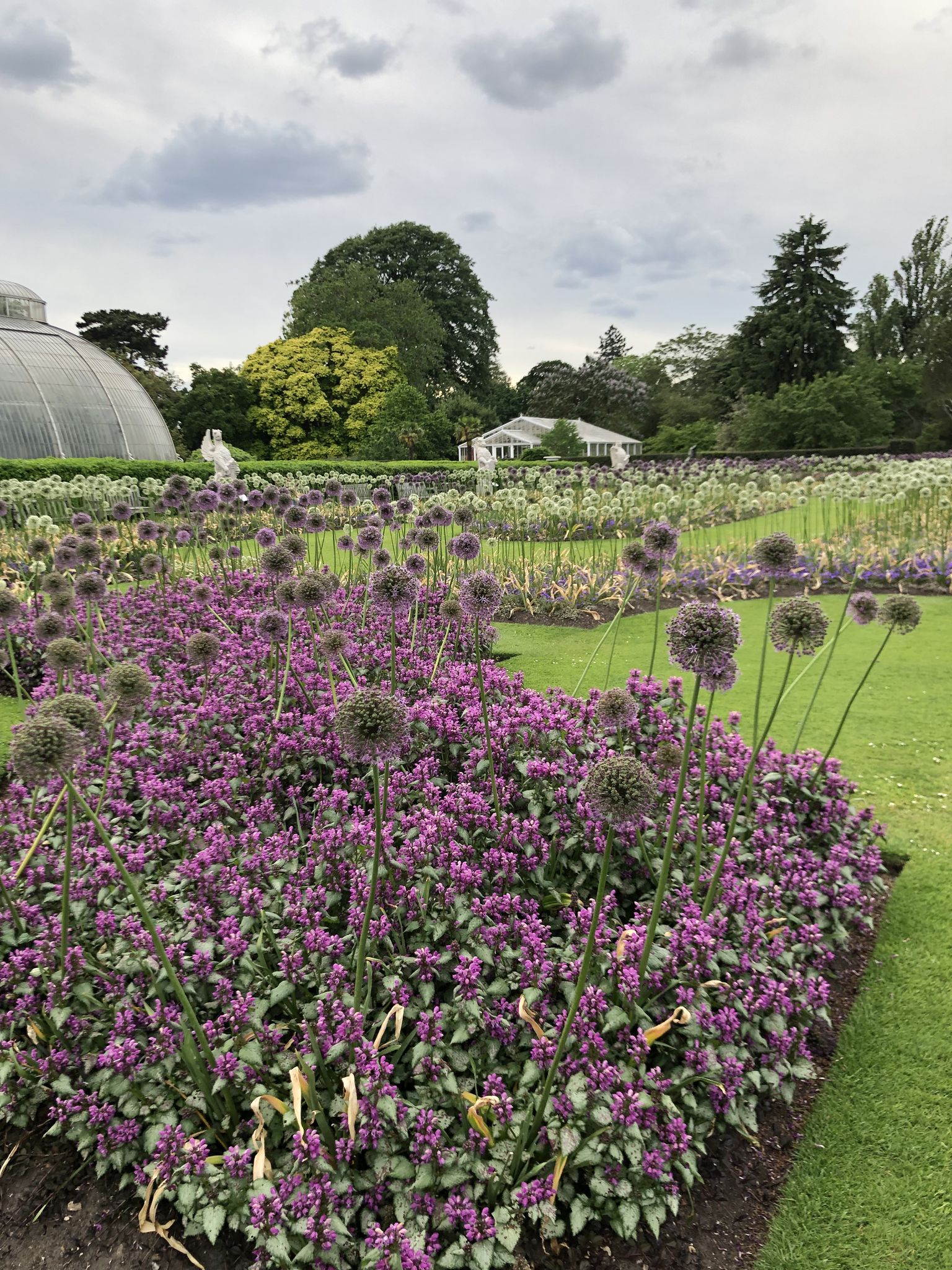
Summer borders and the Palm House at Kew Gardens. Photograph by Greathome.
Kew sits on a bend of the Thames in the London Borough of Richmond upon Thames — a leafy, village-like corner of the city with its own quiet identity: Georgian streets around a historic green, a strong civic society, and a surprising depth of engineering and cultural history behind its residential calm.
What stands out
- A genuinely villagey core around Kew Green, with historic houses, a parish church, and a resident civic society (the Kew Society, founded in 1901) that reviews planning applications to help protect the area's character.
- Deep-rooted industrial history that's now almost invisible from the street — the area once produced viscose rayon, traction engines, aircraft and motor vehicles, including Dodge and Chrysler lorries and cars built at a Kew factory between the 1920s and the Second World War.
- A dense cluster of notable residents past and present, from Thin Lizzy's Phil Lynott to astronaut Helen Sharman, giving Kew a quietly well-connected reputation without much fuss made of it locally.
Trade-offs
- Kew has relatively little independent high-street retail and dining of its own, sitting close to Richmond's much larger town centre.
- Its protected, low-rise Georgian character — closely watched by the Kew Society — limits scope for new housing and redevelopment, keeping the local stock tight.
- Some local amenities have contracted over time: bowls ended at the Priory Park Club in 2017, for instance, a reminder that village charm doesn't guarantee every facility survives.
Things to know about Kew
- Helen Sharman, the first British woman in space, lives in Kew.
- Nobel laureate playwright Harold Pinter lived in Kew from 1960 to 1963, writing his 1961 play The Collection there.
- Thin Lizzy frontman Phil Lynott lived in Kew.
- Patrick Troughton, who played the Second Doctor in Doctor Who, lived in Kew.
- A Kew factory built Dodge and Chrysler lorries and cars from the 1920s until the Second World War, after starting out in 1918 as an aircraft works.
Life here
- The Kew Society, a civic society founded in 1901 as the Kew Union, reviews planning applications and organises talks and outings to protect the area's architectural heritage.
- The Kew Horticultural Society, founded in 1938, runs an annual show in late summer plus talks and outings throughout the year.
- Local sports clubs include tennis at the Priory Park Club, rowing with Putney Town Rowing Club, gymnastics with the Richmond Gymnastics Association, and bowling at North Sheen Bowling Club; Brentford FC's stadium is just across Kew Bridge.
- The Craft Guild of Chefs, the main UK professional association for chefs, is based in Kew.
History and what it is known for
- The name Kew was recorded as Cayho in 1327, combining the Old French kai ("landing place") with the Old English hoh ("spur of land") formed by a bend in the Thames.
- Viscose was first developed into rayon in a laboratory near Kew Gardens station, run by Cowey Engineering, before Courtaulds acquired the rayon patents in 1904.
- The engineering firm F C Blake, commemorated in the street name Blake Mews, produced petrol-powered traction engines in Kew in the late 19th and early 20th centuries.
- A former aircraft factory established in 1918, which had built Airco DH.4s and Sopwith Salamanders in the First World War, became a motor works: Dodge built lorries there under the model name Kew from the 1920s to 1967, and Chrysler assembled De Soto and Plymouth cars (named Richmond, Mortlake, Croydon, Kew Six and Wimbledon) there until the Second World War, when the plant built Handley Page Halifax aircraft assemblies instead.
Notable connections
- Helen Sharman — The first British woman in space lives in Kew.
- Phil Lynott — Thin Lizzy frontman and songwriter who lived in Kew.
- Patrick Troughton — Actor who played the Second Doctor in Doctor Who and lived in Kew.
- Andrew Watson — The world's first black international footballer, who died in Kew in 1921 and is buried in Richmond Cemetery.
- Krishnan Guru-Murthy — Lead presenter of Channel 4 News, lives in Kew.
- Mick Avory — Former drummer with The Kinks, lives in Kew.
Background from Kew on Wikipedia (CC BY-SA 4.0) and Wikidata (CC0), summarised for this guide. Details change — check anything that matters to you.
Everyday life
Life in Kew centres on Kew Green and the streets around it, with community life anchored by long-standing local groups. The Kew Society, founded in 1901 as the Kew Union, campaigns for the area's heritage and reviews planning applications with an eye to architectural integrity; the Kew Horticultural Society, founded in 1938, runs an annual show each late summer alongside talks and outings; and the Richmond Local History Society keeps the area's past in view. Sport is served by a scattering of small clubs rather than large facilities — tennis at the Priory Park Club (its bowls green closed in 2017), rowing with Putney Town Rowing Club, gymnastics with the Richmond Gymnastics Association, and bowls at North Sheen Bowling Club — while Premier League football is a walk away over Kew Bridge at Brentford FC's stadium. The Craft Guild of Chefs, the main UK professional body for chefs, is headquartered locally, a quiet nod to Kew's food-industry links.
Housing character
The area's built fabric leans heavily on Georgian and Victorian houses, many clustered around the historic green, interspersed with twentieth-century flats that replaced some grander houses lost to demolition — one site on Ennerdale Road became a Modernist block of flats, another on Kew Road a later block named after the house it replaced. The Kew Society's close attention to planning applications tends to preserve this low-rise, village character rather than encourage denser redevelopment, which shapes what is and isn't available to buyers and renters.
Getting around
Kew Gardens station sits at the heart of the area, with local bus routes serving the surrounding streets, and Kew Bridge providing a road and pedestrian link across the Thames towards Brentford. Newcomers should check current timetables and routes directly with the operators rather than relying on general impressions of the area's connectivity.
Things to investigate
Anyone considering a move should look into how the Kew Society's planning oversight might affect renovation or extension plans on a Georgian or Victorian property, and check the current admission arrangements for nearby state and independent schools directly with each admission authority rather than assuming proximity guarantees a place. It's also worth remembering that the boundary used here is a postcode-district proxy (TW9), not a precise neighbourhood line, so any published statistic attached to this guide should be read as covering that wider postcode district rather than Kew alone.
Schools
Measured by distance from the area centre, straight line. Primary is a walk and secondary is a journey, so they are counted on different radii. Ofsted's published judgements, not a Greathome rating.
Primarystate-funded, within 2 km
14 schools
- Judged by Ofsted
- 9
- At least Good
- 9
- Outstanding or equivalent
- 1
- Below Good
- 0
Secondarystate-funded, within 5 km
20 schools
- Judged by Ofsted
- 19
- At least Good
- 19
- Outstanding or equivalent
- 9
- Below Good
- 0
23 open schools of every phase sit within 2 km, 6 of them independent. Independent schools carry no Ofsted judgement in this release, so they appear in the total and never in the judged figures. Nothing here establishes catchment, admissions eligibility or available places.
The nearest 6 schools, with their published judgement
| School | Phase | Distance | Published judgement |
|---|---|---|---|
| Broomfield House School | Not applicable | 0.2 km | No published judgement |
| Unicorn School | Not applicable | 0.3 km | No published judgement |
| The King's Church of England Primary School | Primary | 0.3 km | Good · Overall effectiveness, pre-September 2024 |
| Kew College | Not applicable | 0.4 km | No published judgement |
| Kew Riverside Primary School | Primary | 0.8 km | Good · Overall effectiveness, pre-September 2024 |
| Darell Primary and Nursery School | Primary | 0.9 km | Good · Overall effectiveness, pre-September 2024 |
Housing market context
£818,949average house price across Richmond upon Thames, June 2026
A year earlier the same measure was £821,466, a change of -0.3%.
Average price across the whole local authority for one month, from the ONS series built on HM Land Registry UK House Price Index data. It is not a neighbourhood median and not a valuation of any property. Two guides in the same borough share this figure while their streets differ. House-price data is revised, and recent months are the most likely to move.
Source: Average house price by local authority, Office for National Statistics, from HM Land Registry UK House Price Index.
Boundary
Kew, taken as the TW9 postcode district. A postcode-district proxy, not an approved polygon. These are postcode districts standing in for an approved polygon. Present every count as "in these postcode districts", never as a neighbourhood or town-centre figure.
Sources
- Average house price by local authority — Office for National Statistics, from HM Land Registry UK House Price Index
- Get Information About Schools — Department for Education
- Ofsted inspection management information — Ofsted
- Street-level crime data — Police.uk
- Postcode and administrative geography — Postcodes.io / ONS
Evidence checked 2026-09-13. Last content change 2026-09-13. Next review 2026-09-20.
Geography and local records
Local records load separately while you read the guide.
What this report does not cover
- neighbourhood median sale price (not_available): Only a local-authority average is connected, from ONS. A neighbourhood median needs enough geocoded transactions inside the guide boundary, which the per-postcode HMLR queries cannot supply.
- rents (not_available): No rent series is connected. Advertised rents and official all-tenancy measures are different things and neither is available here yet.
- journey times (not_available): No journey planner is connected. Transport is measured as nearby stops, not as time to anywhere. TfL PTAL and journey-time APIs would replace it for London.
- school admissions history (not_available): Admission arrangements are held by each admission authority and are not in the GIAS or Ofsted snapshots.
- licensed premises and venues (not_available): No licensing register or venue dataset is connected. Food-hygiene categories are not a pub register.
- image rights (not_yet_verified): No licensed image library is connected. Return an image brief rather than an asset.
- approved boundary polygon (not_yet_verified): Boundaries are postcode-district proxies. Counts describe the districts named, not a town-centre polygon.