
Area guidesSevenoaks
Sevenoaks
TN13 · Sevenoaks, Kent
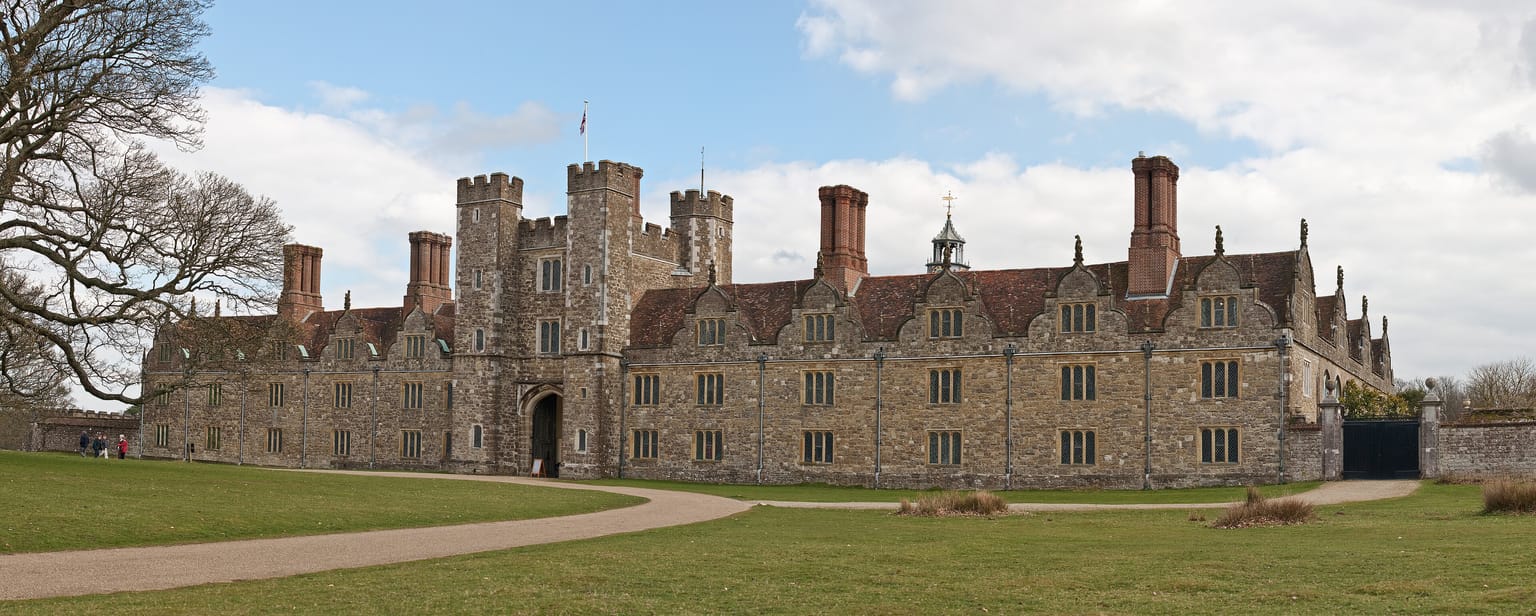
Knole house and its park, Sevenoaks. Photograph by Diliff.
Sevenoaks sits on a ridge in west Kent, a commuter town that has kept a genuinely old market-town centre rather than becoming a dormitory suburb. The High Street still bends past a medieval school gate and the walls of a great deer park, and the town's identity is built as much around Knole and its surrounding green space as around the railway line to London. It reads as prosperous and settled, with a strong pull for families weighing a quieter, greener base against a shorter commute.
What stands out
- Knole Park, an SSIS and medieval deer park of about a thousand acres with the historic house at its centre, sits right against the town, so ancient parkland and a working high street are a short walk apart.
- Sevenoaks School, founded in 1432, and the town's long educational tradition give the place a settled, institutional backbone that shapes its streets and its calendar.
- The town keeps a genuine mix of old and new commerce, from a Saturday food market in the centre to the Bligh's shopping development and a reopened community-run theatre and cinema.
Trade-offs
- It is a well-off commuter town with high demand for housing, and the local economy itself offers a narrower range of middle-class jobs than the commuting workforce needs, so many residents work in London rather than locally.
- The town centre and its approach roads carry heavy traffic at peak times, and congestion is a known feature of daily life rather than an occasional inconvenience.
- Much of the surrounding land is protected parkland and green belt, which preserves the setting but also constrains where and how the town can grow.
Things to know about Sevenoaks
- Diana, Princess of Wales attended West Heath School in Sevenoaks.
- Knole Park is a roughly 1,000-acre medieval deer park at the centre of town, with Knole House, home of the Sackville family since Elizabeth I gave them the estate in 1577, still lived in today.
- RotoSound, the guitar and bass string manufacturer based in Sevenoaks, has had its strings used by Jimi Hendrix, Brian May and Pete Townshend.
- Phil and Paul Hartnoll, the brothers behind the electronic act Orbital, were born in Sevenoaks.
- Sevenoaks School, on the High Street, was founded in 1432 by William Sevenoke and is one of the oldest lay foundations in England.
Life here
- A Saturday food market is held in the centre of town, a continuation of the market tradition the town has held since being granted market status in the 13th century.
- The Stag, a theatre, cinema and music venue, was reopened as a community arts centre by Sevenoaks Town Council in 2009 and now runs as a volunteer-supported charity.
- Knole Park, bordering the town centre, and Sevenoaks Wildlife Reserve, a former gravel pit north of the town now a protected Site of Special Scientific Interest, give residents two very different green spaces close at hand.
- The Vine Cricket Ground, one of the oldest cricket venues in England, sits alongside three non-league football clubs, a hockey club, a padel club and Sevenoaks Suns, a women's basketball team playing in the top domestic flight (the WBBL).
- The High Street shopping area includes the Bligh's development, opened in phases from 2002 on the site of a former bus station and car park, and an M&S store that opened in 2014.
History and what it is known for
- The settlement's name is recorded from 1100 as Seouenaca, thought to derive from Old English for 'the place of the seven oaks', though a 19th-century guidebook offers an alternative theory that it is a corruption of 'Chevenix'.
- Sevenoaks was granted market status by the 13th century, and a weekly cattle market was held in Hitchen Hatch Lane until it closed in 1999.
- Sevenoaks School was founded in 1432 by William Sevenoke, a foundling brought up in the town who became a London merchant, alderman, sheriff and Mayor; it was granted letters patent by Elizabeth I in 1560 as Queen Elizabeth's Grammar School.
- Archbishop of Canterbury Thomas Bourchier bought the Knole estate in 1456 and built Knole House, which has dominated the town ever since; Elizabeth I later gave the estate to the Sackville family in 1577.
- The eponymous oak trees have been replanted several times, most recently after the Great Storm of 1987 destroyed six of the seven trees planted in 1902 to mark Edward VII's coronation.
Notable connections
- Diana, Princess of Wales — Attended West Heath School in Sevenoaks.
- John Donne — Poet, served as Rector of Sevenoaks from 1616 until his death in 1631.
- H. G. Wells — Writer, one of several literary figures with a Sevenoaks connection.
- W. H. Davies — Welsh 'tramp-poet' who lived in Sevenoaks between 1907 and 1914.
- Edward Thomas — Poet with a connection to the town.
- Bill Bruford — Jazz and rock drummer, born in Sevenoaks.
Background from Sevenoaks on Wikipedia (CC BY-SA 4.0) and Wikidata (CC0), summarised for this guide. Details change — check anything that matters to you.
Everyday life
Daily life in Sevenoaks centres on the High Street and the streets around it, where independent shops sit alongside the Bligh's development and a long-established M&S. A Saturday food market runs in the centre of town, continuing a market tradition that stretches back to the town's medieval charter, and it remains one of the more sociable fixed points in the weekly routine. The Stag, a community-run theatre, cinema and music venue reopened by the town council and now run as a charity, gives the town a cultural anchor that many places of similar size lack, with a regular cinema programme and volunteer-supported events.
Green space is unusually close at hand for a town this size: Knole Park borders the centre directly, and Sevenoaks Wildlife Reserve, a former gravel pit north of the town now protected as a Site of Special Scientific Interest, offers a very different, wetland-and-woodland outing. Sport and club life run deep, from three non-league football clubs and a long-established hockey club to Sevenoaks Suns, a women's basketball team playing in the top domestic flight, and cricket at the Vine, one of England's oldest cricket grounds. Scouting, padel, and a busy community forum and events directory point to a town where joining something local is straightforward.
Housing character
Sevenoaks is known locally as an expensive place to buy, a reputation tied directly to its commuter appeal and to the amount of protected land around it. The high street area mixes older townhouses and period properties near the historic core with more suburban family housing radiating outwards, and the presence of Knole Park and the wider green belt has long limited large-scale development, keeping the town compact rather than sprawling. Newcomers should expect a settled, established character rather than a fast-changing one, with the town's institutions, notably its schools, playing a visible part in shaping who moves there and why.
Getting around
The town's commuter identity is built around its rail link toward London, and this is the main reason many residents choose to live there while working elsewhere. Locally, the town centre and the roads feeding it, including the A225 corridor past the main industrial area to the north, are busy and prone to congestion at peak times, a trade-off residents weigh against the ease of reaching London by train. Within the town, the compact centre and the proximity of Knole Park mean many everyday errands and leisure trips can be done on foot rather than by car.
Things to investigate
Anyone considering Sevenoaks should look closely at the balance between its high property demand and the realistic range of local employment, since the economy itself offers fewer middle-class roles than its commuting population needs. It is worth understanding how the protected status of Knole Park and the surrounding green belt affects any specific property or development plans nearby, and confirming current admission arrangements directly with the relevant admission authorities rather than assuming proximity to a school implies a place. Traffic patterns around the High Street and the main approach roads at peak times are also worth experiencing directly before committing to a specific address.
Schools
No school evidence was returned for this area centre.
Boundary
Sevenoaks, taken as the TN13 postcode district, in Kent. A postcode-district proxy, not an approved polygon. These are postcode districts standing in for an approved polygon. Present every count as "in these postcode districts", never as a neighbourhood or town-centre figure.
Sources
- Average house price by local authority — Office for National Statistics, from HM Land Registry UK House Price Index
- Get Information About Schools — Department for Education
- Ofsted inspection management information — Ofsted
- Street-level crime data — Police.uk
- Postcode and administrative geography — Postcodes.io / ONS
Evidence checked 2026-09-13. Last content change 2026-09-13. Next review 2026-09-20.
Geography and local records
Local records load separately while you read the guide.
What this report does not cover
- neighbourhood median sale price (not_available): Only a local-authority average is connected, from ONS. A neighbourhood median needs enough geocoded transactions inside the guide boundary, which the per-postcode HMLR queries cannot supply.
- rents (not_available): No rent series is connected. Advertised rents and official all-tenancy measures are different things and neither is available here yet.
- journey times (not_available): No journey planner is connected. Transport is measured as nearby stops, not as time to anywhere. TfL PTAL and journey-time APIs would replace it for London.
- school admissions history (not_available): Admission arrangements are held by each admission authority and are not in the GIAS or Ofsted snapshots.
- licensed premises and venues (not_available): No licensing register or venue dataset is connected. Food-hygiene categories are not a pub register.
- image rights (not_yet_verified): No licensed image library is connected. Return an image brief rather than an asset.
- approved boundary polygon (not_yet_verified): Boundaries are postcode-district proxies. Counts describe the districts named, not a town-centre polygon.