
Area guidesTeddington
Teddington
TW11 · Richmond upon Thames, London
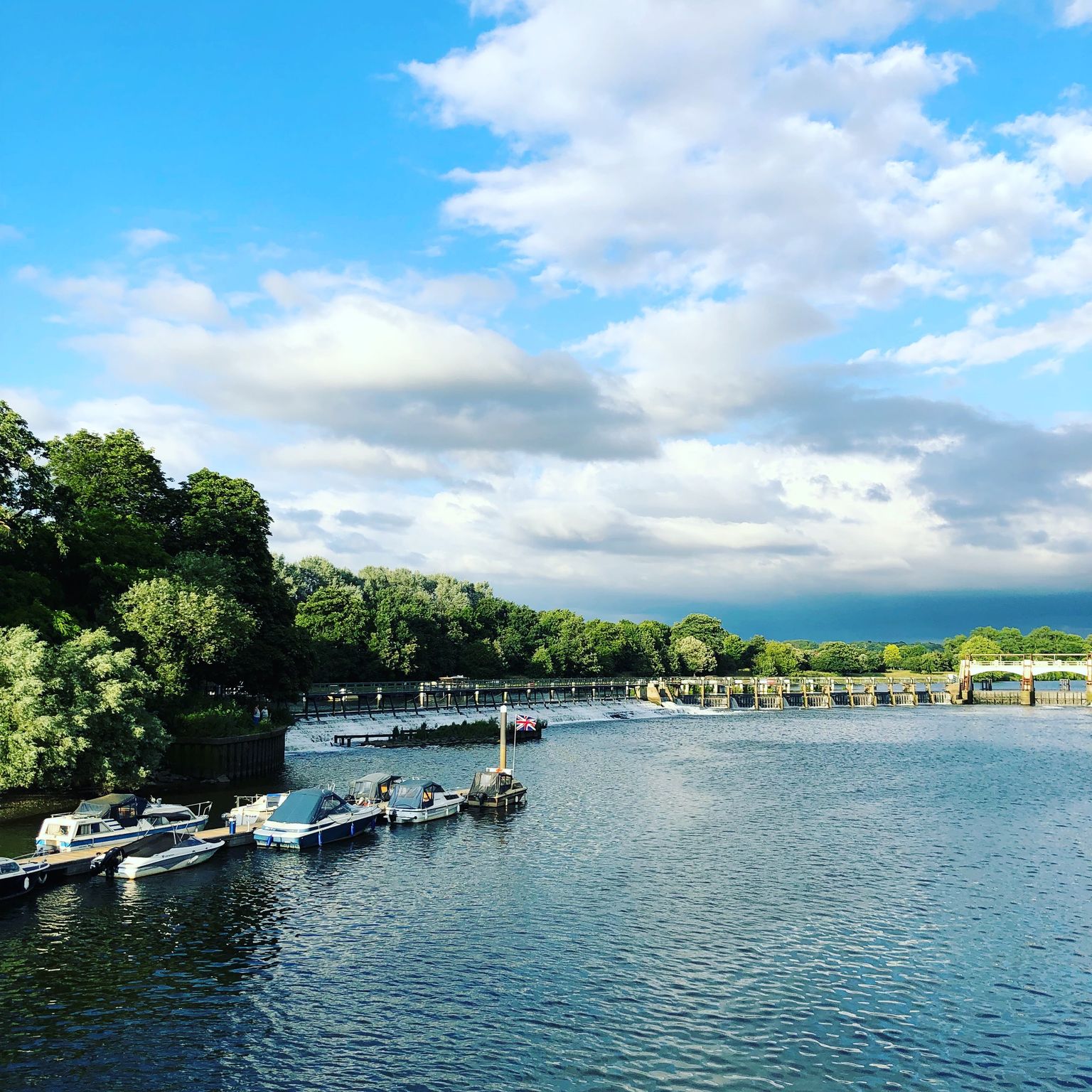
Teddington Lock and weir on the Thames. Photograph by Greathome.
Teddington sits where the tidal Thames finally runs out of tide — the 'final lock' that gave the town its name is still the hinge of the place, with a lock, a footbridge to Ham, and a volunteer lifeboat station all clustered round it. Away from the water, the High Street and Broad Street carry the everyday rhythm of the town, and the presence of the National Physical Laboratory on the edge of Bushy Park gives Teddington a quietly scientific undercurrent alongside its riverside, small-town feel.
What stands out
- A genuine tidal landmark: Teddington Lock marks the point the Thames stops being tidal, and the town's name is popularly linked to 'Tide End Town'.
- An unusually deep sporting heritage for its size, including some of the country's oldest rowing, canoeing and skiff clubs and a hockey club that helped shape the modern game's rules.
- Science and screen heritage side by side: the National Physical Laboratory's landmark work at Bushy House sits a short walk from the former Teddington Studios site, once a home of Thames Television.
Trade-offs
- The commercial spine has two distinct characters: Broad Street leans towards chain shops and cafes, while the High Street is almost entirely independent businesses — it isn't one uniform 'town centre' feel.
- Newer riverside apartment developments, including the redeveloped former studios site, sit alongside close-knit Victorian and Edwardian streets, so architectural character varies noticeably block to block.
- Connectivity runs through a single rail station with no Underground or tram link nearby, so onward travel leans heavily on that one line and the local bus network rather than multiple rail options.
Things to know about Teddington
- The post box on Broad Street was painted gold in 2012 in honour of Teddington resident Mo Farah's Olympic wins that year.
- Actress Keira Knightley grew up in Teddington.
- Teddington Studios, a former home of Thames Television, stood on the riverside here until the site was redeveloped into housing from 2016.
- The National Physical Laboratory, based at Bushy House, developed the Second World War 'bouncing bomb' and built the first accurate atomic clock.
- Playwright and entertainer Sir Noël Coward was born in Teddington.
Life here
- The town's shopping and social life runs along Broad Street (chains, cafes, supermarkets) and the more independent High Street.
- The Landmark Arts Centre, in a former church, hosts concerts, exhibitions and arts classes for the local community.
- Riverside sporting clubs are a major part of local life: rowing, skiff and canoe clubs work the Thames, alongside cricket, hockey, rugby and football clubs.
- Teddington Lock and its footbridges to Ham, along with the towpath, are the town's everyday riverside focus, and the volunteer-run Teddington Lifeboat Station has operated from beside the lock since 2002.
History and what it is known for
- The name 'Teddington' is first recorded in a Saxon charter of 969 as 'Tudintún', meaning the settlement of Tud(d)a's people; a popular but unproven theory instead links it to 'Tide End Town', the point where the Thames stops being tidal.
- Teddington Lock, built in 1811, was the first and remains the largest of the lock-and-weir crossings built on the Thames at the time.
- The arrival of the railway in 1863 triggered rapid growth, turning Teddington from a small village into a commuter town within a few decades.
- The National Physical Laboratory, the UK's national measurement standards laboratory, was established at Bushy House in 1902 and became a major wartime research site, including development of the 'bouncing bomb'.
- During the Second World War, General Dwight D. Eisenhower planned the D-Day landings from his Supreme Headquarters Allied Expeditionary Force at Camp Griffiss in Bushy Park.
- The Landmark Arts Centre building was originally built as St Alban's Church in the Victorian era, intended as a grand 'Cathedral of the Thames Valley', though only the nave was ever completed before funds ran out.
Notable connections
- Keira Knightley — Actress, grew up in Teddington.
- Mo Farah — Olympic long-distance runner, has a home in Teddington.
- Julian Clary — Comedian, author and actor, grew up in Teddington.
- Jed Mercurio — Creator of Line of Duty, lives in Teddington.
- Viv Groskop — Journalist, writer and comedian, lives in Teddington.
- Sir Noël Coward — Playwright, actor and songwriter, born in Teddington (historical, d. 1973).
On screen
- Teddington Studios (Thames Television) — For decades a working television studio complex on the riverside, until its redevelopment into housing began in 2016.
- Catwalk Dogs — 2007 film with a recorded filming connection to Teddington.
Background from Teddington on Wikipedia (CC BY-SA 4.0) and Wikidata (CC0), summarised for this guide. Details change — check anything that matters to you.
Everyday life
Day to day, Teddington centres on its two-part high street: Broad Street for a mix of chains, cafes and supermarkets, and the High Street for independent shops. The Landmark Arts Centre, housed in a former church that was once intended as a much grander 'Cathedral of the Thames Valley', runs a wide-ranging programme of concerts, exhibitions and arts classes and is a genuine community hub rather than a heritage curiosity.
Sport threads through community life here more than most towns its size: a cricket club based at Bushy Park, a long-established hockey club, rowing, skiff and canoe clubs working the river, and several football and rugby clubs give newcomers an obvious way to meet people. The riverside itself — the lock, the footbridge over to Ham, and the towpath — is where a lot of everyday leisure happens, on foot or by boat rather than by car.
Housing character
Much of Teddington's housing dates from the building boom that followed the railway's arrival in 1863, which produced the close-knit network of Victorian and Edwardian streets that still forms the backbone of the town. Later additions include riverside flats built where older riverside businesses and houses once stood, and, more recently, apartment blocks and smaller houses on the site of the former Teddington Studios, redeveloped from 2016 onwards. The result is a town where terraced Victorian streets and newer riverside apartment living sit close together rather than a single uniform housing type.
Offices cluster in two identifiable pockets: a scientific centre on the edge of Bushy Park around the National Physical Laboratory, and a mix of smaller offices — including direct-marketing and IT firms — near the station and town centre, which shapes some of the daytime footfall around those parts of town.
Getting around
Teddington has its own rail station in the town centre, giving direct access onward towards Twickenham, Richmond, Kingston and London, a link that transformed the town from village to commuter suburb after it opened in 1863. There's no Underground or tram presence, so the station and the local bus network carry most onward journeys. On foot, the riverside towpath and the Teddington Lock footbridges connect the town to Ham across the river, and the lock itself is a natural landmark to navigate by.
Things to investigate
The published house-price figure for this guide is a Richmond upon Thames borough average, not a Teddington-specific median, so it's worth treating as context rather than a like-for-like comparison between streets. Similarly, no local rent series or journey-time data is connected here yet, so both are worth checking independently before relying on them for a decision.
If schools are a factor, check the current admission arrangements directly with each school or the local authority, since proximity alone says nothing about admissions chances, and independent schools in the area won't carry an Ofsted-style outcome in the same way state-funded ones do. It's also worth noting that Teddington's postcode-district boundary used here (TW11) is a proxy, not an official neighbourhood polygon, so any counts describe that postcode district rather than a precisely drawn 'Teddington'.
Schools
Measured by distance from the area centre, straight line. Primary is a walk and secondary is a journey, so they are counted on different radii. Ofsted's published judgements, not a Greathome rating.
Primarystate-funded, within 2 km
11 schools
- Judged by Ofsted
- 9
- At least Good
- 9
- Outstanding or equivalent
- 2
- Below Good
- 0
Secondarystate-funded, within 5 km
14 schools
- Judged by Ofsted
- 14
- At least Good
- 14
- Outstanding or equivalent
- 9
- Below Good
- 0
20 open schools of every phase sit within 2 km, 4 of them independent. Independent schools carry no Ofsted judgement in this release, so they appear in the total and never in the judged figures. Nothing here establishes catchment, admissions eligibility or available places.
The nearest 6 schools, with their published judgement
| School | Phase | Distance | Published judgement |
|---|---|---|---|
| St Mary's and St Peter's Church of England Primary School | Primary | 0.6 km | Outstanding · Overall effectiveness, pre-September 2024 |
| Collis Primary School | Primary | 0.6 km | Not judged · Graded inspection, no overall grade |
| Newland House School | Not applicable | 0.8 km | No published judgement |
| Sacred Heart Catholic Primary School | Primary | 1 km | School remains Good · Ungraded inspection |
| St Mary's University, Twickenham | Not applicable | 1.3 km | No published judgement |
| Stanley Primary School | Primary | 1.3 km | Good · Overall effectiveness, pre-September 2024 |
Housing market context
£818,949average house price across Richmond upon Thames, June 2026
A year earlier the same measure was £821,466, a change of -0.3%.
Average price across the whole local authority for one month, from the ONS series built on HM Land Registry UK House Price Index data. It is not a neighbourhood median and not a valuation of any property. Two guides in the same borough share this figure while their streets differ. House-price data is revised, and recent months are the most likely to move.
Source: Average house price by local authority, Office for National Statistics, from HM Land Registry UK House Price Index.
Boundary
Teddington, taken as the TW11 postcode district. A postcode-district proxy, not an approved polygon. These are postcode districts standing in for an approved polygon. Present every count as "in these postcode districts", never as a neighbourhood or town-centre figure.
Sources
- Average house price by local authority — Office for National Statistics, from HM Land Registry UK House Price Index
- Get Information About Schools — Department for Education
- Ofsted inspection management information — Ofsted
- Street-level crime data — Police.uk
- Postcode and administrative geography — Postcodes.io / ONS
Evidence checked 2026-09-13. Last content change 2026-09-13. Next review 2026-09-20.
Geography and local records
Local records load separately while you read the guide.
What this report does not cover
- neighbourhood median sale price (not_available): Only a local-authority average is connected, from ONS. A neighbourhood median needs enough geocoded transactions inside the guide boundary, which the per-postcode HMLR queries cannot supply.
- rents (not_available): No rent series is connected. Advertised rents and official all-tenancy measures are different things and neither is available here yet.
- journey times (not_available): No journey planner is connected. Transport is measured as nearby stops, not as time to anywhere. TfL PTAL and journey-time APIs would replace it for London.
- school admissions history (not_available): Admission arrangements are held by each admission authority and are not in the GIAS or Ofsted snapshots.
- licensed premises and venues (not_available): No licensing register or venue dataset is connected. Food-hygiene categories are not a pub register.
- image rights (not_yet_verified): No licensed image library is connected. Return an image brief rather than an asset.
- approved boundary polygon (not_yet_verified): Boundaries are postcode-district proxies. Counts describe the districts named, not a town-centre polygon.